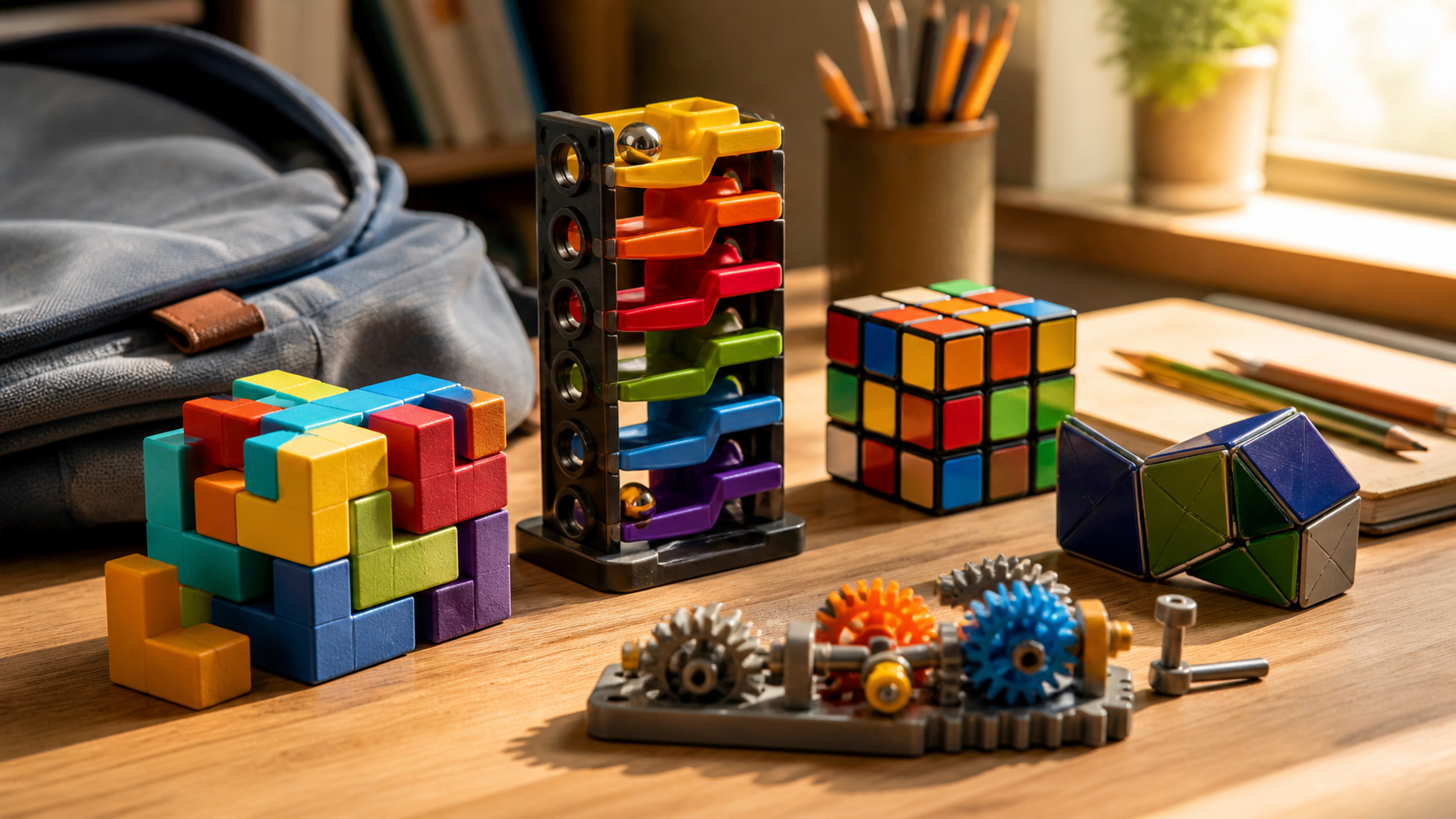
The best after-school puzzle asks for ten focused minutes, not another hour of instruction. It should start quickly, store without drama, and offer a clear reason to try again tomorrow.
These five games suit different kinds of thinkers. I checked the manufacturer and publisher information on August 11, 2026. Prices and stock change, so use the live pages for current buying details.
What matters more than the age on the box
Setup time: A weekday puzzle should be ready before interest disappears.
Storage: Backpack games need a case. Table games need an obvious home for loose pieces.
Progress: Graduated challenges work better than one intimidating objective.
Fit: Spatial fitting, marble routing, algorithm practice, free folding, and mechanical building reward different kinds of patience.
1. Kanoodle Genius: best for a backpack
Ages 8+ · 202 challenges · seven pieces and a carrying case
Check Kanoodle Genius at Educational Insights →
Kanoodle Genius earns the default recommendation because the case doubles as the board. The official listing confirms 202 two- and three-dimensional challenges, with every piece stored inside.
It is a strong match for a child who likes tangrams or Tetris. The pieces are small, so follow the 8+ age recommendation and keep them away from children under three.
2. Gravity Maze: best for builders
Ages 8+ · solo logic game · towers, cards, and marbles
Browse Gravity Maze through ThinkFun →
Gravity Maze turns the answer into motion. Arrange the towers correctly and the marble reaches its target. A wrong route is visible immediately, which makes another attempt feel natural.
This is a home game, not a backpack toy. It needs table space and contains marbles plus other small components. Store the full set out of reach of younger siblings.
3. Rubik’s 3x3: best long-term value
Ages 8+ · one self-contained puzzle
Check the Rubik’s 3x3 at Spin Master →
The standard cube has no pieces to lose and no challenge cards to exhaust. It rewards a child who enjoys practicing one skill until the method clicks.
It is less successful as a casual novelty. Most beginners need a clear solving guide, so include one rather than expecting discovery alone to carry the experience.
4. SHASHIBO: best quiet fidget-puzzle
Magnetic shape toy · more than 70 possible forms
SHASHIBO sits between a puzzle and a fidget. Its hinged magnetic panels fold into many shapes, but there is no required sequence or final win state.
That freedom is useful for decompression. Magnets also require care: never use a damaged toy, and seek urgent medical help if a magnet is swallowed. Keep it away from children below the manufacturer’s stated age.
The magnetic shape-shifting cube guide goes deeper on this category.
5. Klutz LEGO Gear Bots: best guided maker kit
Ages 8+ · 62 LEGO elements · eight mechanical builds
Read the Scholastic Gear Bots overview →
Gear Bots is a project kit rather than a repeatable logic game. Scholastic says it includes a 64-page book, papercraft, and LEGO elements for eight crank-driven models.
Buy it for a child who would rather build the puzzle. It contains small parts and is not suitable for children under three. The official age range starts at eight.
Which one should you buy?
Choose Kanoodle Genius when portability matters. Gravity Maze gives a builder the most satisfying physical result, while Rubik’s 3x3 offers the longest path to mastery.
SHASHIBO is better for unstructured folding than formal challenges. Gear Bots suits the child who wants instructions and a moving model at the end.
For broader tactile play, compare the best sensory toys and the 2026 viral fidget guide. Neither replaces the age and small-parts warning on the actual package.
Safety and household fit
Check every box for its current age grade. Loose puzzle pieces, marbles, magnets, and LEGO elements can create serious hazards for younger children.
Count the parts after play and retire damaged magnetic toys immediately. A “brain game” label does not make a product suitable for every age in a mixed household.